How Your Hormones Change With Age:A Decade-by-Decade Guide
What Changes in Your 30s, 40s, 50s & Beyond

Your hormones were never meant to stay the same. Understanding how they change, decade by decade, can help you navigate what comes next. At Arc Wellness in St. Louis, this is one of the questions our physician-led team hears most often, from patients in their 30s all the way through their 70s.
There is a strange expectation we place on our bodies: we expect them to function at 45 exactly the way they did at 25.
We expect the same energy. The same sleep. The same metabolism. The same strength. The same ability to recover after a long week, a hard workout, or a late night. And when something begins to change, we often assume we're doing something wrong.
Maybe the weight starts settling differently. Sleep becomes lighter. Muscle is harder to maintain. Your mood feels less predictable. Sexual desire changes, or your energy just isn't quite what it used to be.
For women, periods may begin changing long before menopause arrives. For men, the changes can be quieter, a gradual shift in testosterone, strength, recovery, body composition, or sexual function over many years.
Somewhere in the middle of all of this, people often say the exact same thing: "I just don't feel like myself anymore."
But perhaps a better question is: what does your body need in this decade?
Your 30s: Building the Foundation
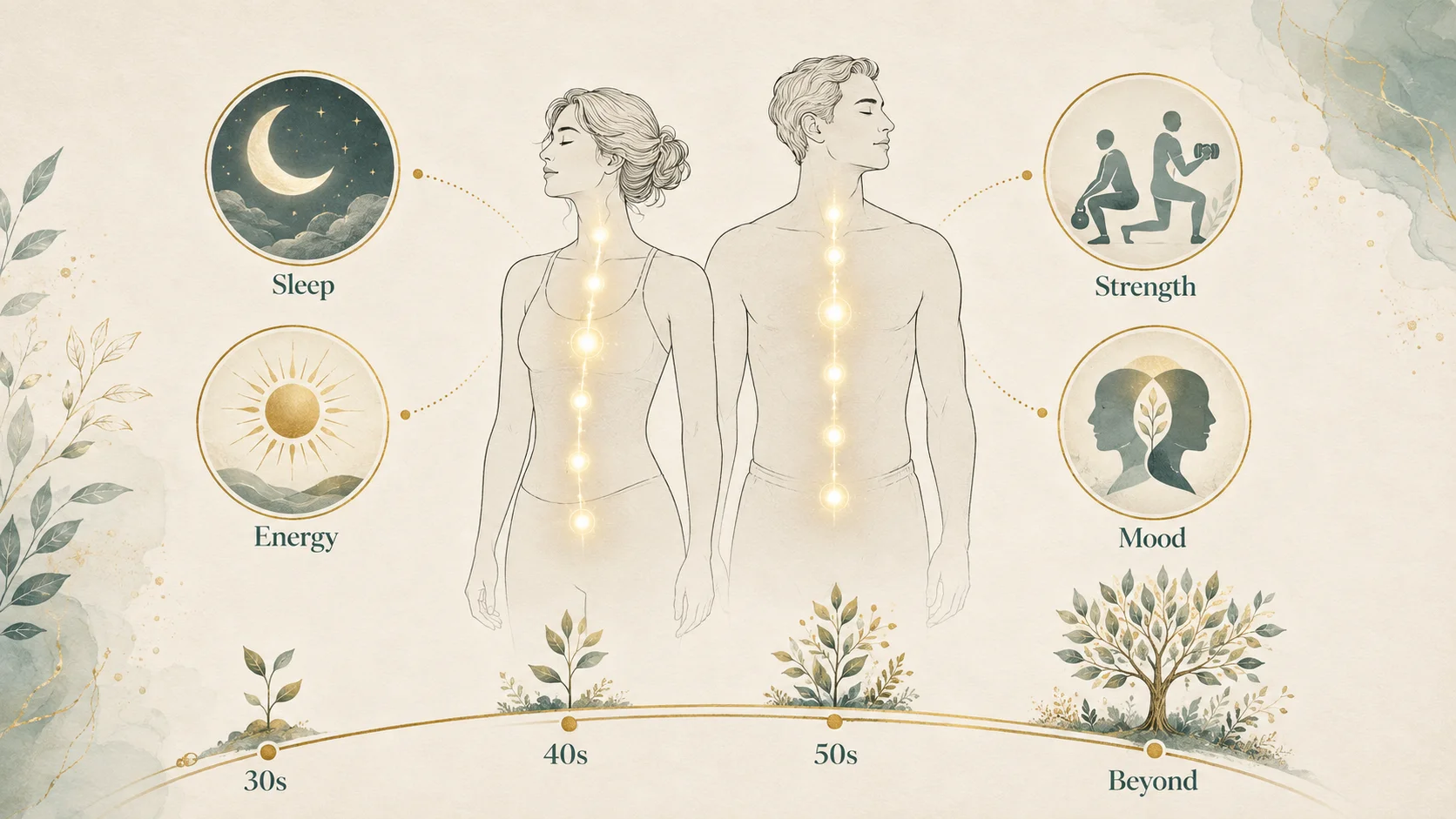
For many people, their 30s still feel relatively familiar. But beneath the surface, this is an incredibly important decade.
Careers are growing. Families are being built. Sleep may be sacrificed. Stress is often high, and exercise and nutrition can easily become whatever fits into an increasingly crowded schedule.
For women, hormonal patterns may begin to shift toward the latter part of this decade, although there is enormous individual variation. Fertility also changes with age, and subtle changes in cycles can sometimes be among the first signs that the hormonal landscape is evolving.
Men may not notice a dramatic hormonal transition, either. Testosterone levels generally change gradually with age, and sleep, excess body fat, certain medications, metabolic health, and other medical conditions can also influence testosterone and how someone feels.
This is why we think of your 30s less as a decade of correction and more as a decade of foundation. The habits built here can influence how you enter every decade that follows.
Focus on the Foundation:
Build muscle
Protect metabolic health
Prioritize sleep
Understand your baseline
Know your family history
Pay attention to changes rather than waiting for them to become problems
Your 40s: When the Signals Often Get Louder

For many women, the 40s are when the hormonal conversation becomes much more noticeable. Perimenopause can begin years before the final menstrual period, and it doesn't always announce itself with classic hot flashes.
Often, it looks like:
Waking up at 3 a.m.
A shorter or unpredictable cycle
New, unexplained anxiety
Brain fog and difficulty concentrating
Changes in body composition
Breast tenderness or headaches
A lower tolerance for stress
The sudden realization that the things you've always done to maintain your weight simply aren't working anymore
Men experience their own midlife changes, although typically without the distinct, rapid hormonal transition that women experience with menopause. Changes in testosterone can occur gradually and may overlap with changes in sleep, metabolic health, stress, medications, and lifestyle. Some men notice reduced energy, declining strength, changes in sexual function, or more difficulty maintaining lean muscle.
The takeaway: the important part is not to assume every midlife symptom is hormonal. But it's equally important not to assume that hormones don't matter. Context is everything.
Your 50s: The Conversation Shifts from Symptoms to Longevity
For many women, the 50s include the transition into menopause. But menopause is not simply the end of menstrual cycles. Estrogen influences tissues throughout the body, which is one reason the conversation at this stage deserves to be broader than hot flashes alone.
For men, this decade can also bring more noticeable changes in strength, body composition, energy, or sexual health. When symptoms suggest a hormonal issue, evaluation should look at the whole person rather than treating a testosterone number in isolation.
This is the decade when we want to think increasingly about what we're preserving. Not just how you feel today, but asking the right questions for tomorrow:
How strong do we want you to be at 70?
How do we protect your bone density?
How do we maintain your muscle mass?
How do we support cardiovascular and metabolic health?
How do we keep you engaged, capable, and independent?
At this stage, hormonal health becomes part of a much larger longevity conversation.
Your 60s, 70s & Beyond: Protecting What Keeps You Living Well

Eventually, the question changes again. It becomes less about trying to feel the way you did when you were younger and much more about protecting the things that allow you to live the way you want to live.
The Pillars of Independence:
Strength & Balance
Cognition
Bone density
Metabolic & Cardiovascular health
Sexual health
Mobility
Hormones remain one piece of that picture, but they are never the entire picture. Nutrition matters. Movement matters. Muscle matters tremendously. Sleep, connection, purpose, and preventive healthcare matter.
Medical decisions, including whether hormone therapy is appropriate, become increasingly individualized based on symptoms, health history, risks, goals, and stage of life.
Because longevity isn't simply about adding years. It's about protecting the life inside those years.
Hormone Care Shouldn't Begin and End With a Number
This is where hormone conversations can become too simple: low number? Replace it. Normal number? Ignore it.
But bodies aren't quite that tidy. A thoughtful hormone evaluation starts with the person, not the lab slip.
The questions we need to ask:
What has changed, and when did it change?
How are you sleeping?
How is your energy?
What has happened to your strength and body composition?
How is your sexual health?
What medications are you taking?
What does your metabolic health look like?
What other medical conditions could be contributing?
Then, we decide whether testing makes sense, and what those results actually mean in context.
Sometimes hormone therapy may be appropriate. Sometimes another issue needs attention first. Sometimes lifestyle changes can have a meaningful impact. And sometimes what you're experiencing is a normal transition that simply deserves better support and understanding.
The goal isn't to chase youth. It's to support health through change.
Supporting You Through the Decades: Right Here in St. Louis
At Arc Wellness, we don't see aging as a problem to solve. We see it as something worth preparing for.
Your 30s shouldn't be managed like your 50s. Your 50s shouldn't be managed like your 70s. And your care shouldn't remain static while your body continues to evolve.
We believe in understanding where you are now, anticipating what may be ahead, and making thoughtful decisions that support the life you're building. Sometimes that includes hormones. Sometimes it includes nutrition, strength, sleep, metabolic health, or preventive, longevity-focused care. Most often, it's a combination.
Because the goal isn't to keep you frozen at one age. It's to help you move through each one strong, informed, and supported.
Through your 30s. Your 40s. Your 50s. And beyond.
Understanding changes everything, and it starts with a conversation. If you're in the St. Louis area and ready to talk through what your hormones and your body may be telling you, our physician-led team at Arc Wellness is here to help.
Ready to talk about hormone health for your decade?
Schedule a physician-led hormone health consultation with Arc Wellness in St. Louis.
Schedule a hormone health consultationFrequently Asked Questions
For many women, subtle hormonal shifts can begin in the late 30s, with perimenopause often becoming noticeable in the 40s. For men, testosterone tends to decline gradually starting in the 30s, though the pace varies widely from person to person.
No. While menopause and perimenopause are common reasons women seek hormone evaluation, men experiencing fatigue, low libido, or changes in body composition related to testosterone may also benefit from a physician-guided evaluation.
Arc Wellness offers physician-led hormone health evaluations at our St. Louis, MO location, combining your personal history, comprehensive labs, and physician guidance rather than treating a single lab number in isolation.
Not necessarily, and not automatically. A normal number doesn't rule out that something is off, just as a low number doesn't always mean therapy is the right next step. That's why context, symptoms, and history matter as much as the lab result itself.
This article is for educational purposes and is not a substitute for personalized medical advice.
Invest in You.Live Fully.Age Intentionally.
We look forward to meeting you
— Dr. Jabbar
We look forward to meeting you
— Dr. Jabbar